A hand marks corrections in pen on printed proofs at a table covered with sheets and stacks, in front of shelves full of books.

Handmade objects and craftsmanship

Independent Publishing

A publisher is not a printer. The printer executes: he receives a file and returns copies. The publisher chooses what deserves to exist in the form of a book, works on it until it holds, decides how it must look and takes on the economic risk of having done so. It is a distinction that seems obvious and that the public confuses continually — and in independent publishing it counts more than elsewhere, because there the two things are often done by the same person.

An iron press on a wooden bench in a bindery, among stacks of paper and sewing frames; a man works at the back before the shelves.

Where

Where it is practised in Tuscany

Tuscany's relationship with printing begins long before modern publishing. Firenze was for centuries a city of presses, binderies and paper makers, and from that supply chain there remains a fabric of neighbouring crafts — paper crafts and bookbinding, marbled paper, hot gilding — that still work today alongside those who publish.

Tuscan independent publishers are concentrated today above all between Firenze, Pisa and Siena, where the university presence feeds the authors and the readers alike. They are for the most part minimal structures: one or two people, a catalogue that grows by a few titles a year, print runs counted in the hundreds. The small scale is the condition that makes it possible to publish a book that will sell three hundred copies, and that no larger structure could afford to print.

Close-up of a book block hand-sewn with linen thread over the cords, beside the needle and a bone folder resting on the table.

How

The techniques of the craft

The work begins with the choice, which is the invisible part and the longest: reading what comes in, understanding whether a text has a reason to exist and whether that reason meets a reader. From there begins the editing, which is a discussion about structure: what to keep, what to cut, where the argument does not hold. Then comes the revision, and in the case of translations a line-by-line comparison with the original.

Then the physical part begins. The graphic design decides the format, the type area, the typeface and the spacing — choices the reader never notices and that determine whether a book can be read without effort. The choice of paper fixes its weight, its opacity, the way the page turns and the colour of the white beneath the ink. The binding — sewn, perfect bound, cased — decides how long the book will last and whether it will open flat on the table.

Printing is almost always done by outside firms, and the choice is between offset, which pays off above a certain number of copies and gives a better result, and digital, which allows very short runs and reprints on demand. It is the decision that most often settles whether a title stands up economically.

There remains distribution, which for the independent publisher is the hardest step of all: getting into the bookshops means relying on a distributor and accepting its terms, and every copy returned comes back at the expense of whoever printed it.

A red-bound book wrapped in tissue inside a cardboard box, beside a stack of copies, a roll of tape and a pair of scissors.

Now

The craft today

Independent publishing lives on a paradox: it produces the books that keep the variety of the Italian catalogue alive, and it operates in the part of the supply chain with the tightest margins. Print runs have shortened, digital printing has made it possible to reprint twenty copies instead of a thousand, and this has removed the risk of the warehouse but raised the unit cost.

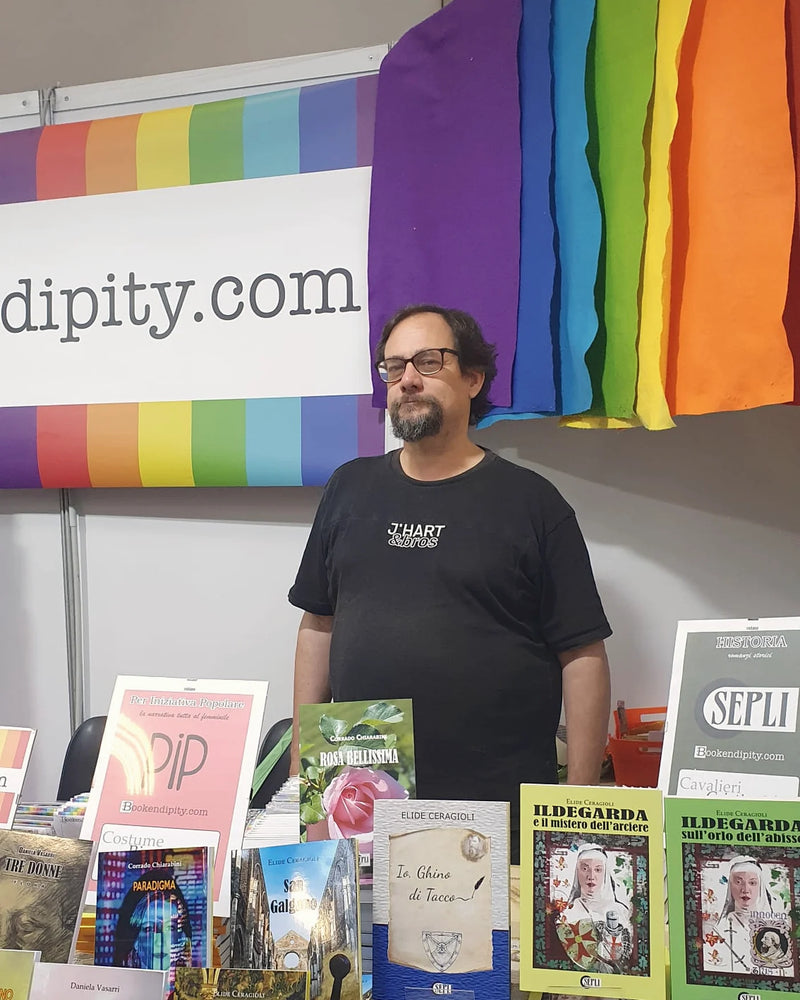
The channel that holds up best is the direct one: sales from the publisher's own site, book launches, festivals, independent bookshops that order on trust. They are all channels in which the book arrives together with the person who made it — and that is exactly the opposite of how large-scale retail works, where the book arrives on its own and has a few days to get itself noticed before being returned.

The producers of this craft