A roaster draws a sample of beans with the trier from the drum of the roasting machine, beside brass scales and a sack of green coffee.

Food and wine

Coffee Roasting

Green coffee does not taste of coffee. It smells of hay, of cereal, sometimes of cut grass, and if you chew it, it is hard as a stone. Everything we call coffee — the brown, the bitterness, the roasted note, the crema — is born in a handful of minutes inside a drum turning over a flame. Roasting is that passage, and it is the point at which an agricultural raw material grown thousands of kilometres away becomes an Italian product.

Jute sacks tied with twine beside a doorway on a wet paved street; an old roasting machine stands in the lit shop window.

Where

Where it is practised in Tuscany

Coffee roasting in Tuscany is an urban craft. It grew up where there were ports and bars: in Livorno, where green coffee arrived by sea, and in Firenze, where drinking at the counter sustained for a century a network of neighbourhood roasters selling ground coffee by weight.

Many of those shops disappeared between the 1970s and the 1990s, absorbed by the large industrial roasters. Those that remained — and those founded over the past twenty years — work on a different scale: small batches, short-cycle roasting, direct sale to the public and supply to a narrow circle of venues. It is a return to the original dimension of the craft, with tools that have meanwhile become far more precise.

The geographical spread still follows the density of bars and the presence of a clientele used to choosing: the coastal provinces and the Firenze area remain the centre of gravity, while in the inland provinces roasting is often tied to a single long-standing business.

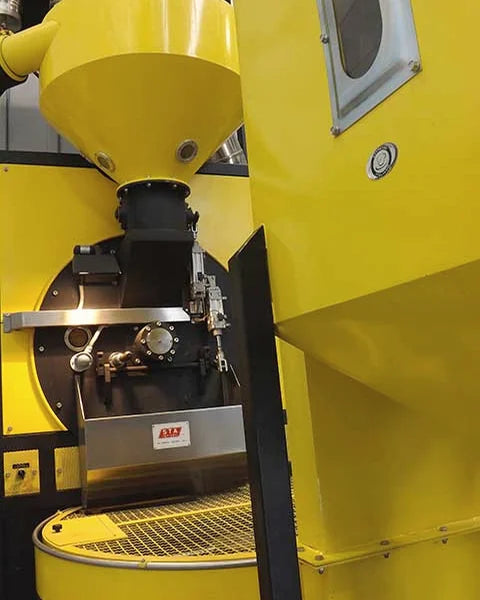
Freshly roasted beans tumble into the perforated cooling tray, pushed along by the slowly turning arm.

How

The techniques of the craft

To roast is to govern a curve. The drum takes the beans from twenty degrees to two hundred and beyond, and the roaster reads two values continuously: the temperature of the mass and the speed at which it is rising.

In the first phase the bean loses water — this is drying, and until it is complete nothing else happens. Then the Maillard reaction begins, the meeting of sugars and amino acids that builds the hundreds of aromatic compounds of coffee, and immediately after it the caramelisation of the sugars, which gives colour and body. At around one hundred and ninety degrees the bean opens with an audible snap, the first crack: from that moment on every second counts, because the profile shifts rapidly from acidity towards bitterness. Stopping shortly afterwards gives a light roast, which preserves the notes of the terroir of origin; carrying on to the second crack gives a dark roast, in which the character of the roasting prevails over that of the bean.

Then comes cooling, which has to be immediate: a bean left hot goes on cooking under its own heat. Then degassing, because freshly roasted coffee releases carbon dioxide and is not yet ready — it takes days, not hours.

The most delicate choice remains: the blend. Assembling different origins serves to obtain a profile that stays constant over time, independent of the vintage of any single harvest. The single origin does the opposite: it accepts variability in exchange for distinctiveness. They are two philosophies, not two levels of quality.

A row of white cupping bowls of brewed coffee on a wooden table, with small mounds of ground coffee and a jar of green beans beside them.

Now

The craft today

The craft has moved upstream. Until thirty years ago the roaster bought green coffee from an importer and worked on the curve; today many choose the lot directly, know the farm it comes from and discuss the processing method — washed, natural, honey — before the drum is even lit.

The second change concerns the drinker. Alongside the espresso at the counter, which remains the dominant form of consumption and has rules of its own, an audience has formed that buys a bag for home and wants to know the origin, the roast date and the recommended brewing method. It is a smaller but more loyal audience, and it has brought direct sales back to the centre of an artisan roastery's accounts.

The producers of this craft