Mokalux

Coffee RoastingFirenzeCalenzano

Torrefazione MP s.r.l. Mokalux

The oak-fired roaster at work

Almost nobody in Italy still roasts coffee over a wood fire. In Calenzano, in the Piana fiorentina, the Piazzesi family has done so since 1920 with oak — and still does, alongside brand-new machinery, because what counts is knowing what happens to the bean.

Founded by Pio Piazzesi in 1920 · four generations · coffee, pods, capsules, specialty · online sales

1920The year of the first roast
4Generations of the Piazzesi family
210°How far the bean goes, and no further
OakThe wood in the roaster's firebox

A hundred years over the same fire

Coffee is a cooking process. And the difference between two cups is decided in twenty minutes, long before anyone switches on an espresso machine in a bar.

Mokalux was founded in Calenzano in 1920 by Pio Piazzesi. Since then the company has crossed a century of Italian coffee — from the loose bean to the bar, from the moka at home to the capsule — remaining in the hands of the same family and holding firm to one detail that almost everyone else has left behind: the fire is wood, and the wood is oak.

Black bag of coffee beans with a cup and beans on jute cloth
The blend in whole beans, the cup and the beans on the jute. Coffee is ground when it is needed, not before.

From one hundred to two hundred and ten degrees, in twenty minutes

The Mokalux roast rises gradually: it starts at one hundred degrees and reaches two hundred and ten within twenty minutes. It is the heart of the craft. Rising too fast means burning the outside and leaving the inside raw; rising too slowly means cooking the bean without developing it. That curve is the signature of a roastery, and each one has its own.

Here the curve is made by the wood fire. It is the traditional method the company states it has kept for more than four generations: oak wood, not gas. Those who still do it, in Italy, can be counted.

New machines, old hand

It would be convenient to tell this roastery as a museum. It is not. The company states that it uses highly innovative machinery and, at the same time, that it has not lost its artisan soul — the two things sit in the same sentence, and it is not a contradiction.

It is the difference between preserving a tool and preserving a know-how. A tool can be updated; the decision about when to stop the fire cannot. That stays where it has always been, that is, in a person watching the colour of the bean.

Every lot has a character

The thing the public understands least about coffee is why blends exist. The answer Mokalux gives is technical and honest: every lot has a personality of its own. Coffee is an agricultural product, it changes from harvest to harvest and from plantation to plantation, and if it were bagged just as it comes the customer would find a different cup every time.

Blending different qualities serves two purposes: making the coffee rounder, that is, without sharp edges, and making it consistent — what you buy in March must taste like what you bought in November. It is a work of balance that is redone at every change of lot, and that nobody sees.

Out of this work come the house blends: Mokalux, Extra Bar, 100% Arabico and the Speciale Monorigine Arabica.

Green bag of coffee beans with a cup and beans
The second blend in whole beans. Two different roasts from the same fire: the oak wood does not change.

The most debated coffee in the world

On the specialty shelf there is the Indonesian Kopi Luwak, which the company itself presents for what it is: one of the most debated and most expensive coffees in the world. Debated because it comes from a process that passes through the digestive tract of the civet, and because in Indonesia there is an intensive production that keeps the animals in cages.

Mokalux puts the clarification in the product profile: the coffee it sells comes from plantations where the civet lives free. It is the kind of line a careless seller does not write, because it obliges you to know where the goods come from.

Pack of single-origin Kopi Luwak with the window onto the beans
The Indonesian Kopi Luwak, single origin. The window on the pack is there to show the bean before selling it.

Six months inside a rum barrel

The other highlight of the specialty shelf is the Columbia Supremo Rum: one hundred per cent arabica, kept for six months inside barrels that held tafia — the raw sugar-cane distillate from which rum is obtained. The wood passes on to the bean what it has absorbed.

Beside it stand the Jamaica Blue Mountain, the Ethiopia Sidamo, the Cuba Serrano, the Nepal Mt. Everest and a Brasil Catucai with an offset carbon footprint. It is a shelf you would not expect from a provincial roastery, and it says that here coffee is bought by people who know what they are looking for.

The capsule made by those who make the coffee

There is a good irony in a roastery from 1920 producing compatible capsules. But it is exactly the craft: this is how people drink their coffee, and those who have been roasting it for a century can put their own blend inside instead of leaving the field to those who do not make the blend.

The range covers the real formats of Italian homes: ground for the moka and for espresso, one-kilo whole beans for those with a machine, paper pods, capsules compatible with the most widespread systems. Same roast, different containers.

A company inside the Piana, not above it

In March 2025 Alice Piazzesi spoke to the local press on behalf of Mokalux. The subject was transport, the tramway, the roads of the Piana fiorentina. These are the problems of those who every day have to get sacks in and parcels out of Calenzano.

It is a detail worth more than ten lines of storytelling. Mokalux is a business immersed in the concrete problems of the Florentine production territory, and it speaks up when it needs to.

School groups in the roastery

In October 2024 Mokalux joined the twelve businesses of the second edition of A Scuola di impresa, the project run by the CNA of the Piana fiorentina that takes students inside companies. On 30 November of that year the roastery opened its doors for the open day; it had already held one of its own in December 2023.

The CNA also devoted a workshop-visit page to it. Those who roast over wood, evidently, have something to show that does not come across on a slide.

Hario hand coffee grinder
The hand grinder. Grinding is the last step, and the only one that falls to the person who drinks.

The video

What is done by hand, on any given morning

Selecting, blending, roasting, packing. Four verbs, and the third is the one nobody else still does this way.

Chemex carafe with its paper filters
The Chemex and the paper filters. Slow extraction is the sternest test of a roast.

Chooses the qualities

Before the blend there is the selection: the company chooses different qualities of coffee and only then puts them together. It is the stage at which it is decided what the cup will taste like six months from now.

Lights the oak

Roasting is done with the traditional oak-wood method, kept for more than four generations. It is not folklore: wood gives a different rise in heat from gas.

Holds the curve

From one hundred to two hundred and ten degrees within twenty minutes, rising gradually. The bean develops inside and does not burn outside: that curve is the whole craft.

Redoes the balance every time

Every lot has a different personality. The blend is re-tuned at every change, so that the customer finds the same coffee again even when the raw material has changed.

Packs for every machine

Ground for the moka, ground for espresso, one-kilo whole beans, paper pods, compatible capsules. The same coffee, inside the container the drinker has at home.

Opens the doors

Open days and visits to the roastery, with school groups too, together with the CNA of the Piana fiorentina. A wood fire is something worth showing.

On the shelf

The house blends, the pods and the capsules, the specialty shelf, and what has been added to sit in the cup alongside the coffee.

Gold bag of the ground Blend Intenso
The ground Blend Intenso. Ground coffee is for those who have a moka, and the moka is still the majority of homes.

The Lavazza Point, Nespresso and A Modo Mio trademarks are cited solely to indicate the compatibility of the capsules with the respective systems. Mokalux is not connected with or affiliated to the owners of those trademarks. Chemex and Hario are trademarks of their respective manufacturers, whose articles the company resells.

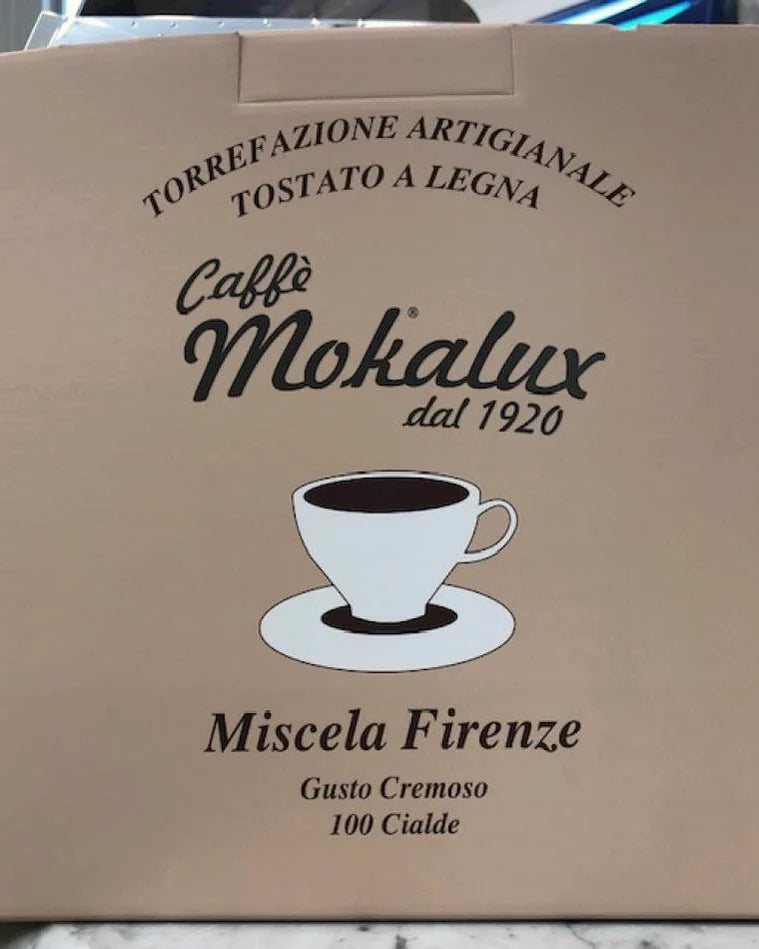
Box of one hundred Miscela Firenze pods
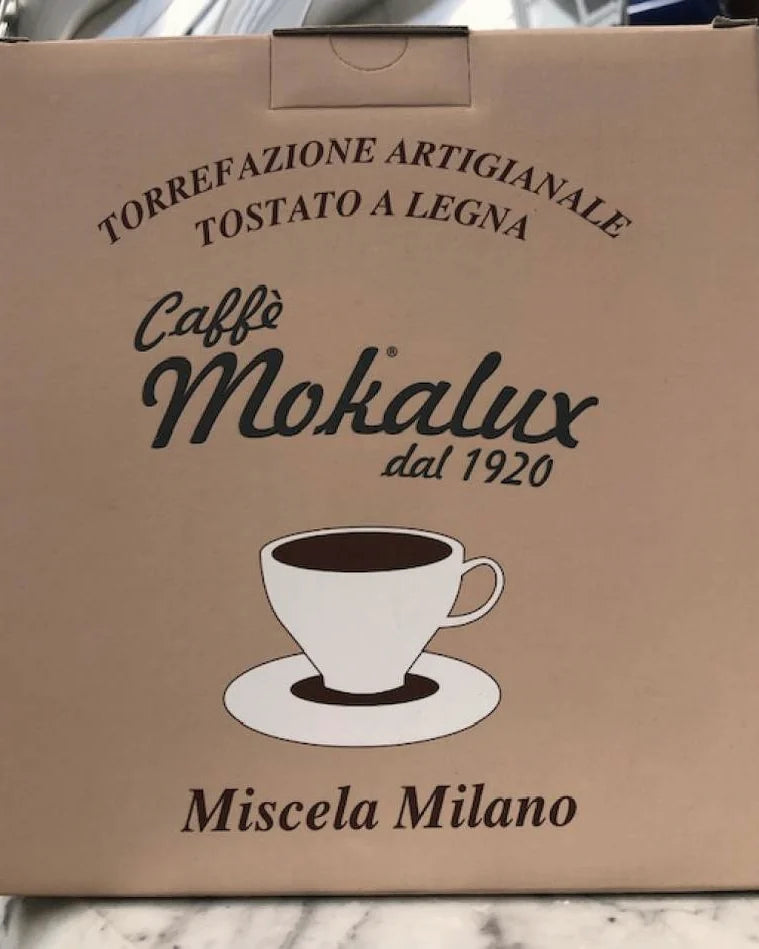
Box of one hundred Miscela Milano pods
Gold bag of the ground Blend Cremoso
The Blend Cremoso. Two blends, two characters: the choice is made in the cup, not on the label.
Pack of fifty compatible capsules, Intenso blend
The compatible capsules. A centenarian that goes into a capsule machine betrays nothing: only the way of arriving changes.
Mokalux

The house blends

Two characters and all the formats needed. Intenso is the blend with body, Cremoso the softer one in the cup; the grind changes according to whether the coffee ends up in the moka or in the espresso machine, and for those who grind their own there are the one-kilo beans.

Mokalux

Pods and capsules

The same roast, inside single-dose formats. The pods are paper; the capsules are compatible with the most widespread domestic systems — the one for Lavazza Point in the Intenso variety is a blend of half arabica and half robusta.

Mokalux

Specialty and single origin

The shelf for those who study coffee. One country, one plantation, no blend: here the character of the lot is not smoothed away, it is shown.

Mokalux

The liqueurs

What is drunk after the coffee, or with it. The lemon liqueur comes from a collaboration with a Florentine distillery; the coffee cream liqueur starts from the house raw material.

Mokalux

The spices

Tellichery pepper comes from the Malabar coast and is among the most aromatic on the market: berries left to ripen longer on the plant. In the two cuts, for those who grind and for those who do not.

Mokalux

The accessories

The tools for extracting at home what the roastery has built into the bean. Chemex for filter, hand grinder, and the system for cold extraction in summer.

Who is behind it

A single surname, repeated four times across a century.

Pio Piazzesi

The founder. In 1920 he opened the roastery that still bears his name in the company's historic sign. The method he chose then — the wood fire — is the one used today.

The generations in between

The company describes itself as led for more than a hundred years and by four generations of the Piazzesi family. They are the hands that carried the same roast from loose coffee to the capsule, without changing it.

Maurizio Piazzesi

At the head of the company today, and he is the one who roasts: his is the hand on the roaster and on the heat curve, as has been done in the family for four generations.

Alice Piazzesi

She works alongside her father Maurizio and is the voice of the company outside the roastery. In March 2025 she spoke to the local press for Mokalux, and not about coffee: about transport and infrastructure in the Piana. A business that discusses the territory in which it works.

The road, so far

2026

The catalogue on Tuscany Market Hub

The blends and the capsules with their own page, their own photographs and their prices, alongside the roastery's own shop.

11 March 2025

Mokalux speaks up about the Piana

Alice Piazzesi speaks in the local press on behalf of the company, on the tramway, the roads and incentives for local businesses.

30 November 2024

Open day with the students

The roastery opens its doors to school groups on the visiting day of the CNA project.

31 October 2024

Among the twelve businesses of «A Scuola di impresa»

Second edition of the project run by the CNA of the Piana fiorentina, which takes students inside the companies of the territory.

2 December 2023

Mokalux Open Day

A day of open doors at the roastery, in Calenzano.

1920

Pio Piazzesi lights the fire

The roastery is born. From then on, four generations and the same oak wood.

Where to find it

Via dei Gelsi, Calenzano: the Piana fiorentina, that is, the place where Firenze works.

Address
Via dei Gelsi 16
50041 Calenzano (FI)
Website

Questions

What is wood-fired roasting?

It is the traditional method in which the heat of the roaster comes from burning wood rather than from gas: the wood is added to the machine's firebox — the fire is not in direct contact with the bean. Mokalux uses oak wood and states that it has kept this practice for more than four generations. The roast rises gradually from one hundred to two hundred and ten degrees within twenty minutes: it is the heat curve that decides how far the bean develops inside without burning outside.

Where is the roastery?

At Via dei Gelsi 16 in Calenzano, in the province of Firenze, in the Piana fiorentina.

How long has Mokalux existed?

Since 1920, when Pio Piazzesi founded it. The company describes itself as led for more than a hundred years and by four generations of the Piazzesi family.

Why is coffee a blend and not a single bean?

Because coffee is an agricultural product and every lot has a personality of its own. Blending different qualities makes the cup rounder, that is, without sharp edges, and above all consistent over time: the packet bought in March must taste like the one bought in November. Those who prefer the character of the single lot will find the single origins on the specialty shelf instead.

Will the capsules work with my machine?

The company produces capsules compatible with the most widespread domestic systems — Lavazza Point, Nespresso and A Modo Mio — as well as paper pods. They are compatible capsules, not originals of those brands: they contain the roastery's own blend.

What is Kopi Luwak?

It is the Indonesian coffee that the company itself calls one of the most debated and most expensive in the world: the beans pass through the digestive tract of the civet before being processed. The product profile specifies that the coffee sold comes from plantations where the animal lives free, not from caged farming.

What is the Columbia Supremo Rum?

A one hundred per cent Colombian arabica kept for six months inside barrels that held tafia, the raw sugar-cane distillate from which rum is obtained. The wood gives to the bean what it has absorbed.

Can it be bought online?

Yes, from the company's shop: you need to register, and the minimum order is thirty euros. The products are also on Tuscany Market Hub.

The coffee is on Tuscany Market Hub

Here we tell who roasts it and how. There is the catalogue: every product with its own page and its own size.

The business

Brand
Mokalux
Historic sign
Pio Piazzesi · since 1920
Address
Via dei Gelsi 16 · 50041 Calenzano (FI)
Craft
Coffee roastery
Founded
1920 · Pio Piazzesi
Generations
Four
Roasting
Traditional · over oak wood
Channels
Online sales · visits to the roastery

This profile is part of the archive for Coffee Roasting. All the producers in the network.