Pasta Bertoli

Pasta and Baked GoodsPisaSanta Luce

Società Agricola Bertoli — Molino e Pastificio sul Lago Pasta Bertoli

Two hands running through the ears of durum wheat in the field

From the heart of Tuscany, the pasta that comes from our own land. Today we farm the unspoilt hills of Santa Luce ourselves. From our organic wheat — and only ours — we make an artisan pasta, bronze-drawn and dried slowly at low temperature. A short supply chain taken to its limit: complete transparency from the field to the packet, with a name and a date on every pack.

The family land since the post-war years · the Pasta Bertoli brand since 2013 · Santa Luce (PI), between the hills and the sea

'50sThe blacksmiths' workshop it all starts from
150Hectares farmed at Santa Luce, plus the woodland
2013The year the wheat becomes pasta
30Hours of slow drying, at 35-40 degrees

One family, three generations, a single stretch of country: the chain that begins in the soil

The Bertoli story does not begin with wheat. It begins with iron, in a blacksmiths' workshop in the 1950s — and it has never once left Santa Luce.

The story of Pasta Bertoli does not begin with wheat, but with a deep understanding of the land and of the tools that work it. In the 1950s, in a blacksmiths' workshop at Santa Luce, in Tuscany, the Bertoli family built and repaired machinery for the farmers around them. From there the next step was almost inevitable: working the fields themselves as contractors, and finally owning and keeping the land.

Today the farm runs around 150 hectares of organic hillside overlooking the lake of Santa Luce, an unspoilt stretch of country where the local authority strictly forbids the use of industrial and urban sludge. Since 2013 this exceptional wheat has been turned into their own premium organic pasta.

The circle closed in 2006, when the family's old workshop was carefully restored to become the La Ghiraia farmhouse inn: the place where the family's pasta is served every day, evidence of a genuine and unbreakable bond between the land, handwork and the table.

A combine harvester at work in a wheat field at sunset, on the hills
The combine harvester at sunset. The date of the harvest is not decided by the calendar: it is decided by the wheat.

Iron first, then the land

In the 1950s the Bertoli family beat iron: their workshop repaired and built for other people's farming. The next step was almost natural — working the fields as contractors, with their own machines — and the one after that was the leap: their own land, their own farm. In the 1980s Giuseppe Bertoli takes over from the family.

The circle closes on a detail that seems written for the purpose: in 2006 the family's old workshop is restored and becomes the La Ghiraia farmhouse inn. Where other people's machines were once mended, today the table is laid — and in the kitchen there is the pasta of the house.

The right hillside for wheat

Santa Luce lies between Pisa and the sea: a landscape of clay hills, well ventilated, with a lake at its centre. It is not only picture-postcard scenery but a real technical advantage: on this ground fungal diseases struggle to take hold, and durum wheat finds ideal conditions in which to ripen.

Here the Bertoli family grows selected varieties of durum wheat: alongside modern cultivars such as Creso and Levante there is room for old and historic grains like Senatore Cappelli and Saragolla, in strict observance of certified organic farming — green manure, crop rotation, organic fertilisation.

They have chosen to farm organically, using no chemicals at any stage of cultivation: it means producing less, but in full respect of the environment around them.

«Producing less in order to produce better is not a marketing slogan: it is an agronomic choice that you pay for in quintals and cash in as quality.»
— Pasta Bertoli

2013: the wheat becomes pasta

For decades the Bertoli wheat left for other people's pasta factories and mills, like everybody else's. In 2013 the family decides the harvest deserves a name of its own, and Pasta Bertoli is born. There is one founding rule, and it is written on the technical sheet of every shape: the dough is made exclusively with semolina from organic durum wheat grown on their own farm, with no semolina added from outside sources.

The method does the rest: the semolina comes from milling, the dough is only semolina and water, the extrusion is through bronze — which gives the pasta a rough surface, ideal for holding the sauce — and the drying is slow, up to thirty hours at low temperature (35–40 degrees), so that proteins, aromas and nutrients stay where they are. No glyphosate, no pesticides.

A field of ripe wheat under a cloudy sky, with a figure in the distance
July, and the field is ready. From here to the bronze die it is a matter of a few weeks and no middlemen.

A supply chain you can read on your phone

«Short supply chain» is a phrase that by now says everything and nothing. Here it can be checked: production is traced from sowing to packaging, and Pasta Bertoli is among the companies in the TrackIT Blockchain project run by the Italian Trade Agency — there is a QR code on the pack, and behind the QR code is the story of that wheat, recorded step by step. Transparency is a ledger.

The cultivated fields sloping down to the lake, with the hills behind
The lake that gives the mill its name. The fields reach right down to the shore: between the wheat and the die the distance is measured in single kilometres.

Six flavours, and the world

Beside the classic organic semolina line lives the coloured six-flavour line: chilli, summer truffle, saffron, porcini mushroom, wine, cuttlefish ink. These are the shapes that catch the eye at tasting counters and that travel furthest: today Pasta Bertoli is already a presence in Europe and looks with ambition and realism to the high-potential Asian markets, Japan and South Korea.

The range is completed by Tuscan pici — the shape of the house: thick, tenacious and stubborn, asking for slow cooking and a craftsman's respect in the finishing — by the fine egg pasta, by the ready sauces drawn from tradition, and by the organic extra virgin olive oil pressed from the farm's three thousand and more centuries-old olive trees. A whole larder of fine things, born of the same unmistakable Tuscan soil.

A pasta factory in the middle of the wheat

In February 2026 the project the family cares about most begins to take shape among the fields of Santa Luce. The storage silos, built in 2020, are already there to hold the farm's grain: the aim is to build the farm pasta factory inside the estate itself, cradled by the wheat hills, and so close the last link in the chain at last. The plant will be fully operational by the end of 2026.

«A farm pasta factory in the middle of a wheat field.» Silvia Bertoli's words.

It is the destination of a story consistent to the point of stubbornness: a family that began by mending other people's machines and that today has chosen a radical road — to make sure its own wheat never leaves the gate again except inside a packet of pasta signed Bertoli.

Aerial view of the cultivated fields on the Tuscan hills
The fields from above: the wheat that ends up in the pasta grows inside this frame, and nowhere else.

The film

What they do with their hands, in any given year

A supply chain is a sequence of gestures. These are the ones, in the order of the seasons.

A man kneeling to check the soil of the field
The check out in the field, on your knees. No laboratory replaces this step.

They sow, and let the land rest

Crop rotation, green manure, organic fertilisation: fertility is built with plants, not with chemistry. It is the certified organic method, applied across the whole of the farm.

They harvest their own wheat

In July the family's combines go into the fields at home — a hundred and fifty hectares between hill and lake. The harvest ends up in the farm's own silos, variety by variety, without mixing with anyone else's wheat.

They add nothing

Two things never enter this chain: semolina bought outside, and haste. And two more never leave the gate: colourings and preservatives, because there are none. The colour of the six-flavour pasta comes from the chilli, the saffron and the cuttlefish ink — not from an additive.

They extrude through bronze

The bronze die leaves the surface of the pasta rough and porous: it is the detail you feel under the sauce, and the reason handmade pasta does not slide about the plate.

They dry it slowly

Up to thirty hours at low temperature, where industry finishes in a few hours at high heat. The long time preserves proteins, the scent of wheat and the way it holds in the pot.

They record every step

From sowing to packaging the chain is traced, on blockchain too with the TrackIT project of the Italian Trade Agency: the QR code on the pack opens the documented story of that wheat.

The larder

The products in the range are all born of the same wheat. Here they are told line by line; on Tuscany Market Hub each has its own page, with photographs and a specification.

Pack of pici from Molino e Pastificio sul Lago, styled
Pici drawn through bronze. The bronze die leaves the surface rough, and it is the roughness that holds the sauce.
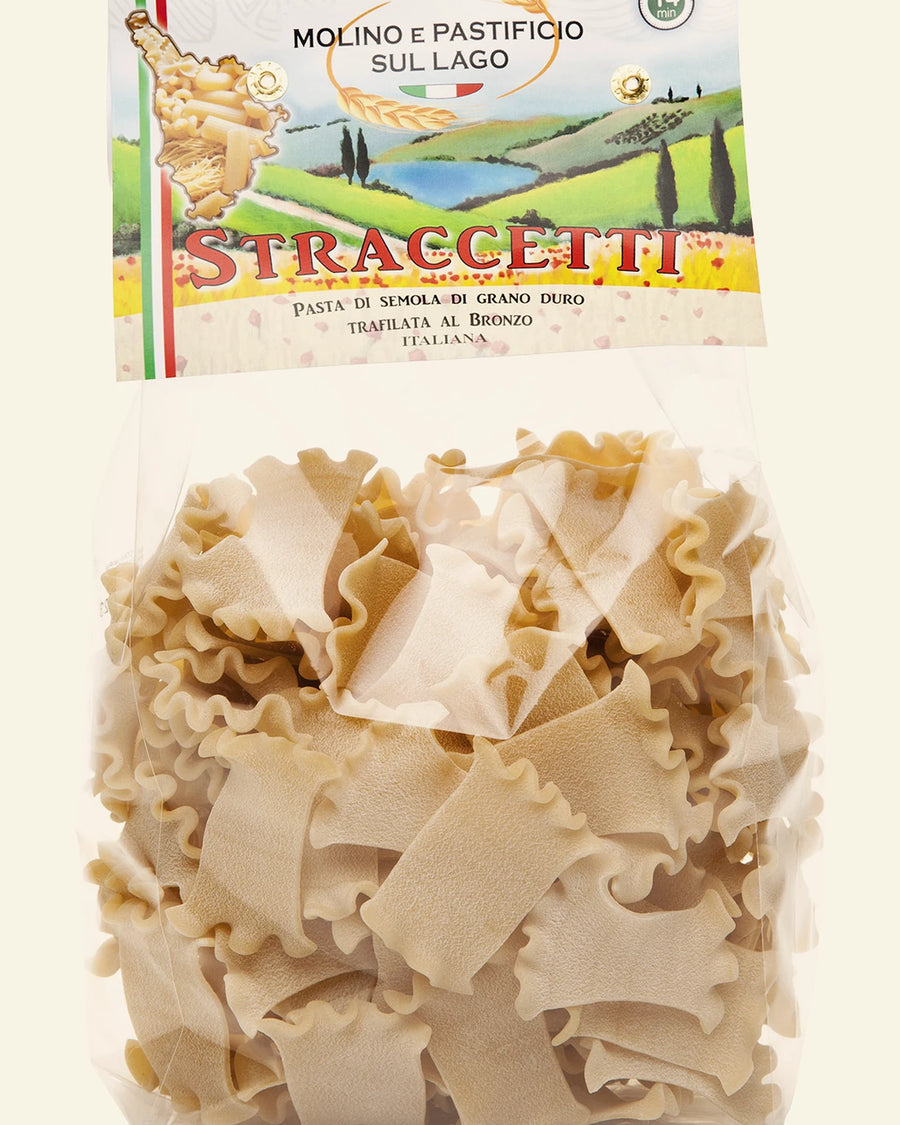
Pack of straccetti, styled
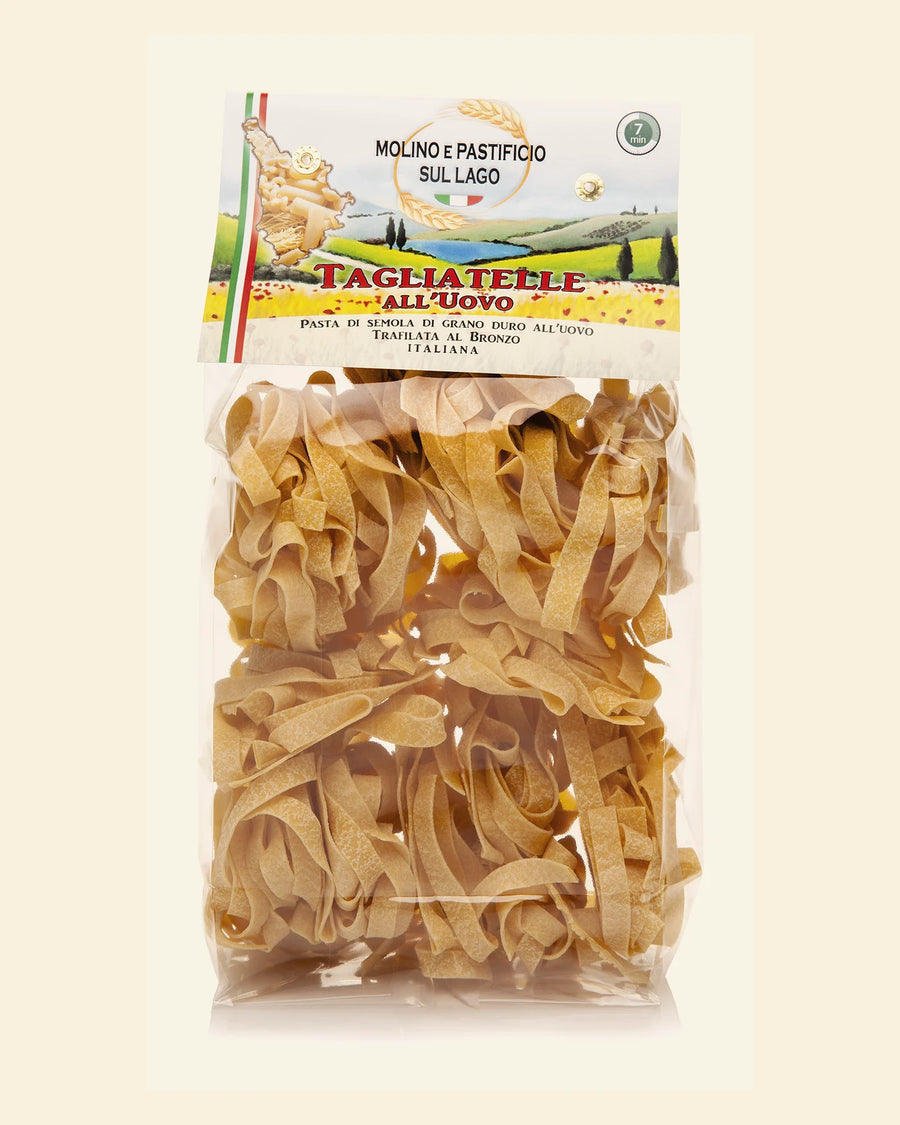
Pack of egg tagliatelle, styled
A plate of pasta with radicchio and shavings of cheese
At the table: the place where twelve months of work are judged in three minutes.
Pasta Bertoli

The organic semolina

The classic shapes drawn through bronze, made only of semolina from the farm's wheat and water. Beside the names everybody knows there are the ones that raise a smile: calamari ridged on the inside, olive leaves, sweets, whistles, bow ties.

Pasta Bertoli

Tuscan pici

The shape of the house: thick, stubborn, made for serious sauces. Around twenty minutes' cooking, and grandmother's rule written even on the technical sheet: do not stir them until the end.

Pasta Bertoli

The egg pasta

The long Sunday sheets: pappardelle, tagliatelle, tagliolini. The same semolina of the house, plus the eggs.

Pasta Bertoli

The six flavours

The coloured line that travels furthest, above all abroad. The colour is the ingredient.

Pasta Bertoli

The ready sauces

The sauce ready in the jar, thought out for the right shape: aglione for the pici, arrabbiata for the penne, the hot spaghettata for midnight.

The same soil

The tasting box

For anyone who wants to taste the whole picture there is the tasting box: grains, pici and sauces in a single parcel.

The family

A family farm has no departments: it has relatives. Each with their own piece of the chain.

Giuseppe Bertoli

The third generation's torchbearer: since the 1980s he has run the farm and followed the grain from sowing to growth. He is the link between the fathers' workshop and today's fields. His is the running of the Pasta Bertoli project, and his the declared dream of the pasta factory in the middle of the wheat.

Silvia Bertoli

The pasta and the selling: she is the voice of the business outside the fields — sales, trade fairs, customers, export.

Federica Bertoli

Administration: the part of the chain made of figures, documents and orders going out. With Silvia she is the company's direct contact.

Matteo and Niccolò

The young ones of the family, already in the fields beside Giuseppe: the fourth generation learning the trade where it has always been learnt, on the tractor.

Mamma Tiuccia

The farmhouse inn and the kitchen at La Ghiraia: the place where the pasta of the house ends up on the plate, at a genuinely short distance.

The voices from the kitchen

Chefs and food professionals who talk about the pasta in the company's own material — Daniele Fagiolini, Paolo Sommariva, Roberta Capanni, Carmine Jovine, Roberto De Franco. One of them came across it at a local dinner, and never let it go.

From iron to wheat, and back

By the end of 2026

The pasta factory in the middle of the wheat

The silos are already in place in the fields of Santa Luce: with the farm's own pasta factory the last link in the chain closes inside the gate of the house.

2026

The catalogue on Tuscany Market Hub

The family's catalogue is on the marketplace: every format with its own page and its technical specification.

7–9 February 2026

Pitti Taste, Firenze

Fortezza da Basso, Central Pavilion, stand F45: their debut at the national food fair, with the six flavours in the front row.

2020

The grain storage silo

Construction of the silo for storing the farm's grain, in the fields of Santa Luce.

2019

The warehouse extension

Extension of warehouse storage, to keep pace with growing production.

5 October 2016

Società Agricola Bertoli

The family gives the business its present form: a simple partnership whose object, on the companies register, is the growing of cereals and the production of pasta from its own cereals.

2013

Pasta Bertoli is born

The wheat of the house stops leaving anonymously and becomes a name: bronze die, slow drying, only the farm's own semolina.

2006

The workshop becomes a farmhouse inn

The family's old workshop, restored, opens as the La Ghiraia farmhouse inn: where farm machinery was once mended, today you eat the pasta of the house.

1950s → 1980s

From iron to wheat

The blacksmiths' workshop, contract farm machinery work, then land of their own. In the 1980s Giuseppe takes over the family business.

Where to find them

One hillside to start from, many roads out: the online shop, the delicatessens, the farmhouse inn, export.

Address
Via di Franata 18
56040 Santa Luce (PI) — loc. Pastina

Questions

Who makes organic artisan pasta in Tuscany?

The Bertoli family, a farm at Santa Luce (Pisa), under the name Pasta Bertoli — Molino e Pastificio sul Lago. The pasta is made exclusively with semolina from the durum wheat grown on the farm's hundred and fifty hectares, certified organic, drawn through bronze and dried slowly at low temperature.

What does «bronze-drawn pasta» mean?

The die is the mould — a perforated plate — through which the dough of semolina and water is pushed to give the pasta its shape. «Bronze-drawn» means that this mould is made of bronze, a softer and more traditional metal than the teflon used by modern industry.

The choice has a direct effect on the surface of the pasta: the bronze die creates friction on the dough, leaving the surface rough, matt and porous. Teflon dies, by contrast, produce a pasta that is smoother, glossier and more slippery.

The roughness is not only a matter of looks: it is precisely that micro-porosity that lets the sauce cling instead of sliding off, so that every forkful carries more of it. The greater roughness also releases starch more gradually during cooking, which helps creamier emulsions — think of a carbonara, or a sauce finished in the pan.

Why is slow drying at low temperature better?

Slow drying at low temperature is better because it avoids «cooking» the pasta during production, keeping its original character. In industry pasta is dried in a few hours at high temperature (over 75–80 °C), an aggressive process that denatures the proteins, alters the aromas and can reduce how well the pasta holds in the pot. In craft production, as at Pasta Bertoli, drying takes up to thirty hours at low temperature (35–40 °C), gradually and with respect for the raw material. This keeps the nutritional properties intact — proteins, amino acids — brings out the scent and flavour of the wheat, and gives a firmer texture that holds al dente. In short: less thermal stress means pasta that is more nourishing, more fragrant and better to eat.

Is Pasta Bertoli really a short supply chain?

Yes, and it can be checked: the wheat is only the farm's own — the technical sheets state that no semolina is added from outside sources — and the chain is traced from sowing to packaging, on blockchain too with the TrackIT project of the Italian Trade Agency. The QR code on the pack opens the documented story of the product.

Which grains do you grow?

Durum wheat varieties selected for the clay hills of Santa Luce, among them the historic grains Senatore Cappelli and Saragolla alongside Creso and Levante. Cultivation follows the certified organic method: rotation, green manure, organic fertilisation.

What are pici and how are they cooked?

They are the traditional Tuscan shape: a thick spaghetto, made for serious sauces — aglione above all. The Pasta Bertoli ones ask for around twenty minutes' cooking and one rule only, written even on the technical sheet: do not stir them until the end.

What is the six-flavour coloured pasta?

It is the company's special line: chilli, summer truffle, saffron, porcini mushroom, wine and cuttlefish ink. The colour comes from the ingredient, not from an additive — no colourings or preservatives go into Bertoli pasta. It is the line that travels furthest abroad.

Where can you buy Pasta Bertoli?

In the company's online shop, on Amazon, in a network of delicatessens and food shops, at the La Ghiraia farm stay in Santa Luce — and on Tuscany Market Hub, where every format has its own page.

The pasta is on Tuscany Market Hub

Here we tell who makes it and how. There is the catalogue: a page for every product, with ingredients, weights and formats.

The business

Registered name
Società Agricola Bertoli s.s.
Registered office
Via di Franata 18 · 56040 Santa Luce (PI) — loc. Pastina
Warehouse and pasta factory
Via dell'Impero 26 · Pomaia · Santa Luce (PI)
VAT number
02233130505
EU VAT
IT02233130505
REA number
PI‑191500
Legal form
Simple partnership · (formed on 5 October 2016)
Registered activity
Growing of cereals and production of pasta from its own cereals
Brands and trading names
Pasta Bertoli · Molino e Pastificio sul Lago · La Ghiraia

This profile is part of the archive for Pasta and Baked Goods. All the producers in the network.