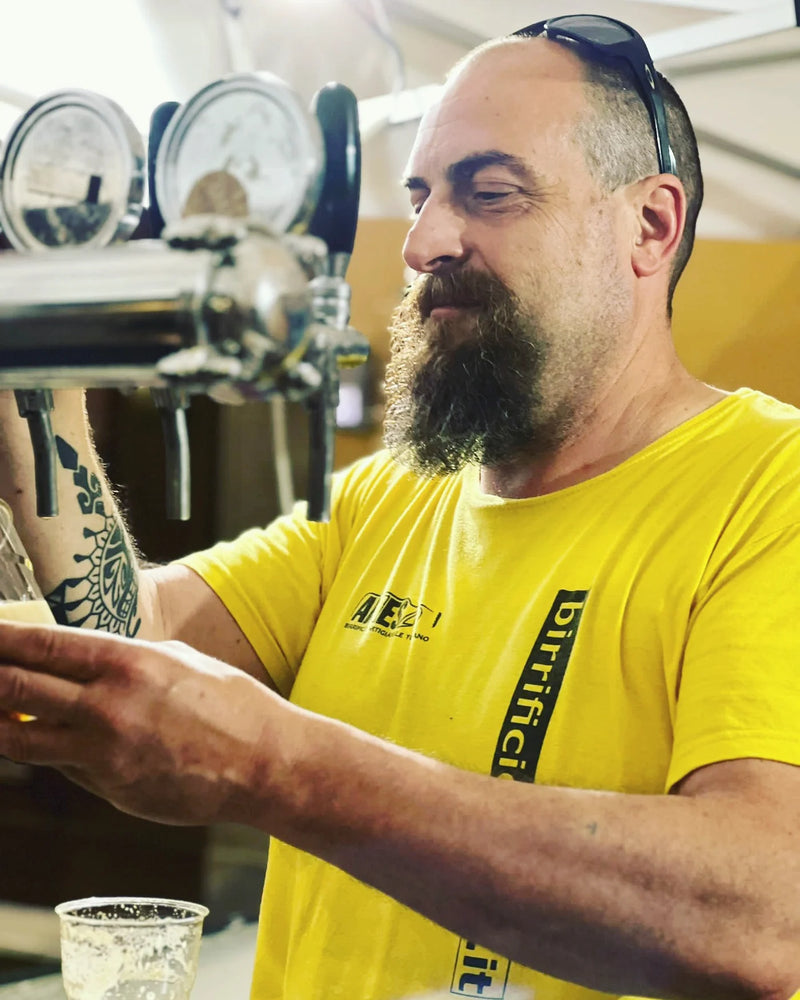
A brewer drops a handful of malt into a steaming steel mash tun, beside a crate of hop cones and a test tube of beer.

Food and wine

Craft Beer

In Italy «craft beer» is a definition in law. Article 35 of law 154 of 2016 reserves it for beer produced by a small, independent brewery that does not exceed two hundred thousand hectolitres a year and that subjects it to neither pasteurisation nor microfiltration. Three technical constraints, and taken together they say one thing only: that the product stays alive, and that whoever makes it answers in person for what comes out of the plant.

Steel kegs and wooden crates in the gravel yard of a rural stone building; fermentation tanks are visible through the open doorway.

Where

Where it is practised in Tuscany

In Tuscany the breweries were almost all founded after the year two thousand, and they have spread differently from the historic manufacturing districts: they do not cluster in a single place, but follow the water, the available industrial units and the markets that consume them.

The coastal strip — Livorno, the Pisan seaboard, the Versilia — has a density tied to restaurants and tourism, with breweries that often open beside a taproom. The Firenze and Prato area works instead with an urban public and with a network of wine bars and shops that has learnt to treat beer as it treats wine. In the inland provinces, from the Mugello to the Val d'Orcia and on to the Maremma, the breweries are smaller and more closely tied to the agricultural raw material of the place: chestnuts, ancient grains, honey, fruit.

This geography also explains the type of plant. Those in the city work with modest volumes and rapid turnover; those in the countryside produce fewer batches and keep them maturing for longer.

Green hop cones float on the wort boiling inside a steel kettle, wrapped in the steam that rises over the rim.

How

The techniques of the craft

Beer is born from four ingredients: water, barley malt, hops, yeast. The rest is time and temperature.

It begins with the mash: the milled malt meets hot water, and the enzymes turn the starch into fermentable sugars. This is the step in which the brewer decides the body of the beer, because the temperature at which the mash is held determines how many of those sugars the yeast will later be able to eat. Next comes the lautering of the wort from the spent grain, and the boil, during which the hops go in: those added at the start give bitterness, those added at the end give aroma. Two opposite gestures made with the same ingredient.

Then the wort is cooled quickly — the most delicate moment, because this is when contamination can get in — and the yeast is pitched. In top fermentation, at around twenty degrees, the yeast produces esters and the beer takes on fruity and spicy notes; in bottom fermentation, at around ten, the profile becomes clean and the work passes to the malt. Finally the maturation, which in many Tuscan breweries closes with a refermentation in the bottle: a small quantity of sugar and yeast is added, and the bubble forms inside the glass, as in the classic method of wine.

The water is not a detail: its mineral profile changes the extraction of the bitters and the perception of body. Many breweries correct it, and some choose their style on the basis of the water they have.

A dark glass bottle, just capped and beaded with condensation, on a wooden bench with loose crown caps and barley grains scattered beside it.

Now

The craft today

The brewer's craft is today divided into two figures that the public often confuses. There are those who own a plant and work on it, and those who design the recipes and have them produced at somebody else's plant — the so-called beer firm. Neither is illegitimate, but they are different jobs, and it is worth the buyer knowing which one is in front of them.

The surge of the 2010s has settled: growth through new openings has stopped, and selection now rewards the breweries that have built stable distribution and a quality that can be repeated batch after batch. Direct sales — from the brewery, at markets, in the places that pour on draught — remain the channel that best sustains the margin, because it skips two steps and allows the product to be told while it is being poured.

The producers of this craft

Each one does it in their own way.